Field notes
What has to be on an invoice: UK, EU, US, Canada, Australia, India and the Gulf
There is no world invoice. There is a short list that always belongs, then a tax ID and a tax treatment that change with the country. Here is a working map for a one-person firm that bills more than one place.
5 Sept 2026 · 8 min read · MyOnlineInvoice
- Regions mapped
- 8
- Always print
- 5
- Tax ID
- 1
- Guessing
- 0
UK, EU, US, CA, AU, IN, UAE, KSA
Who, whom, what, when, how much
VAT / EIN / ABN / GSTIN / TRN
Confirm the current rate on the revenue site
Process
- 1
Set the legal name and country in Settings
The document header is the entity, not the trading nickname.
- 2
Store the right tax ID for that country
VAT number, EIN, ABN, GSTIN or TRN — one field, printed every time.
- 3
Pick the tax treatment per line
Standard, reduced, zero, exempt, reverse charge, or no tax. Not a vibe.
- 4
Name the customer with an address
B2B VAT reclaim and US exemption certificates both die without a who.
- 5
Unique number, never reused
Every regime hates recycled invoice numbers. Gaps you can explain; resets you cannot.
- 6
Confirm the rate on the official site
Thresholds move. This article is a map, not a filing.
By country
Checklist, not a filing. Confirm the live rate with that authority.
| Region | Tax | ID on the invoice | Must print | Watch |
|---|---|---|---|---|
| United Kingdom | VAT (usually 20%) | VAT number (GB…) | Legal name, unique invoice no., tax point, net/VAT/gross, customer address | Do not charge VAT if you are not registered. Threshold is set by HMRC — confirm on GOV.UK. |
| European Union | VAT (country rate) | VAT ID (prefix + number) | Full VAT invoice for B2B; reverse charge note if you invoice another VAT ID | Distance sales / OSS for B2C goods. Services have different place-of-supply rules. Confirm in that member state. |
| United States | State sales tax (not federal VAT) | EIN on the document; sales-tax permit in the state | Who you are, who they are, description, date, amount, tax charged (or exempt reason) | Nexus is state-by-state. A job in another state can create a collection duty. No national invoice statute like VAT. |
| Canada | GST / HST (and QST in Québec) | GST/HST number | Business name, GST/HST number, invoice date, amount, tax shown separately | HST vs GST+PST depends on the province of the supply. Québec has QST as well. |
| Australia | GST 10% | ABN; GST if registered | Identity, ABN, what was supplied, GST amount (tax invoice rules) | A ‘tax invoice’ is a defined document once you are GST-registered. Quotes are not tax invoices. |
| India | GST (CGST/SGST or IGST) | GSTIN | GSTIN of both sides where required, HSN/SAC, place of supply, tax breakup | E-invoicing turnover thresholds apply to many firms. Interstate vs intrastate changes the tax split. |
| United Arab Emirates | VAT 5% | TRN | TRN, sequential invoice, Arabic may be required on some records, tax amount | Designated zones and reverse charge on certain imports. Confirm with FTA guidance. |
| Saudi Arabia | VAT 15% | VAT registration number | ZATCA e-invoicing (Fatoora) for many taxpayers — Phase 1/2 rules | Paper-looking PDFs are not enough if you are in the e-invoicing phases. Integration is the product. |
There is no such thing as a worldwide invoice. There is a document that always answers five questions — who is charging, who is paying, what was done, when, and how much — and then a tax story that belongs to one country.
If you copy a UK VAT footer onto an Australian job, or put “plus GST” on a Texas invoice, you have not become global. You have become wrong in two places at once.
| Region | Tax | ID to print | Do not |
|---|---|---|---|
| United Kingdom | VAT | VAT number | Charge VAT if unregistered |
| European Union | VAT | VAT ID | Assume UK VAT on German site work |
| United States | Sales tax | EIN + state permit | Print VAT 20% on a Texas job |
| Canada | GST / HST / QST | GST/HST number | Charge 5% in an HST province |
| Australia | GST | ABN | Treat a quote as a tax invoice |
| India | GST | GSTIN | Skip e-invoice if you are in the net |
| UAE | VAT 5% | TRN | Ignore designated-zone rules |
| Saudi Arabia | VAT 15% | VAT no. + Fatoora | Email a PDF and call it Phase 2 |
This is a map for a small firm that sometimes bills outside the postcode. It is not a filing. Rates, thresholds and e-invoicing mandates move; the *shape* of the problem does not. Confirm the current rule on that country’s revenue site or with the accountant who actually signs the return.
The five lines that travel
Every serious invoice on earth needs:
- Your legal name and address (the entity, not the Instagram handle).
- Their name and address.
- What you supplied, in words a stranger could audit.
- A date and a unique number.
- The amount, with the currency named.
If you get those five right, you can add the local tax ID and the local tax treatment without redesigning the page. If you miss them, no amount of crest or colour saves you.
The tax ID is not decoration
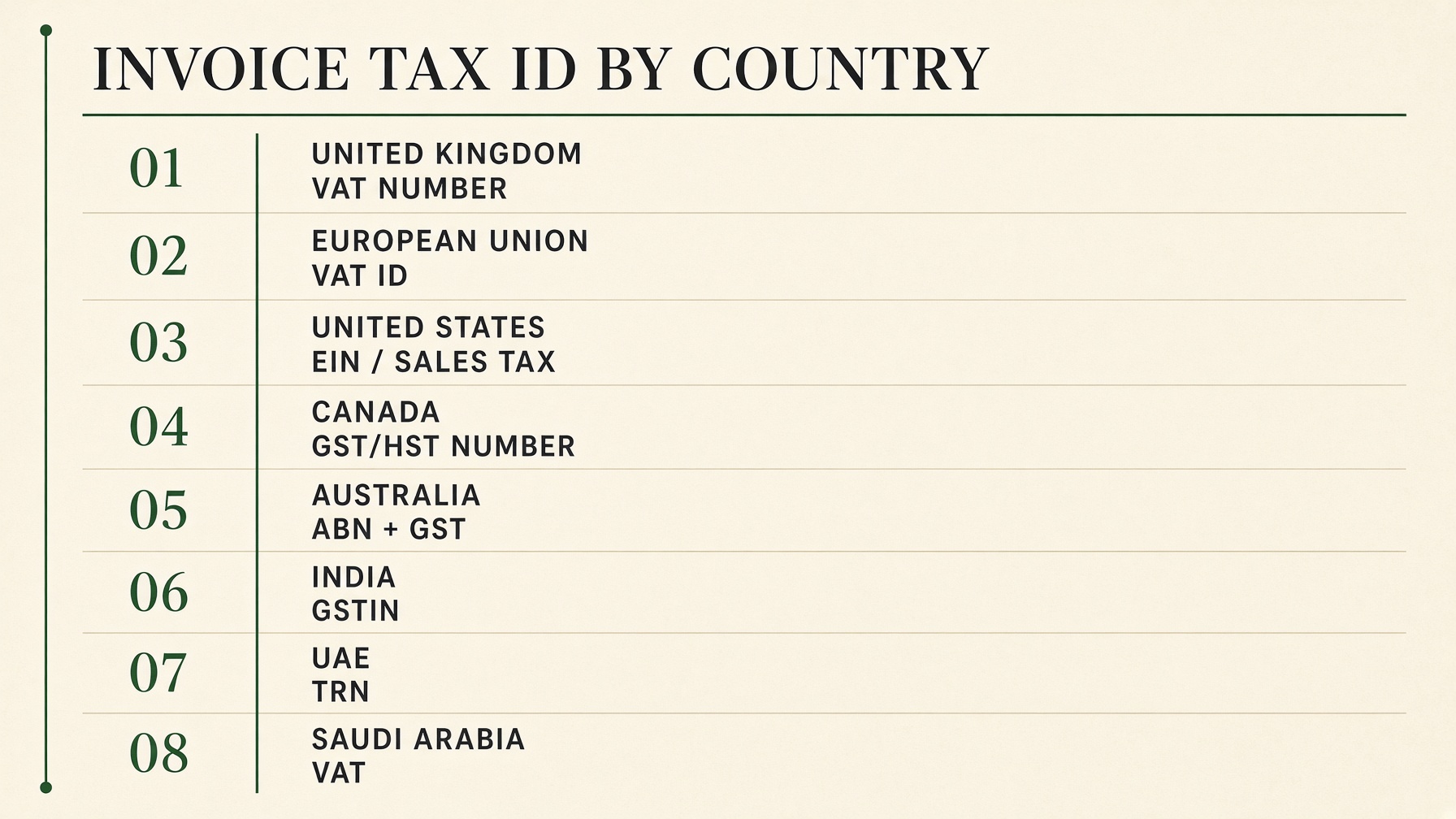
The second layer is the identifier the tax authority uses to match you:
- United Kingdom — VAT number (and Companies House name if you are a limited company).
- EU member state — VAT ID with the country prefix.
- United States — EIN on the invoice is good hygiene; sales tax is a state permit, not an IRS VAT.
- Canada — GST/HST number.
- Australia — ABN, and GST on a *tax invoice* if you are registered.
- India — GSTIN, often on both sides for B2B.
- UAE — TRN.
- Saudi Arabia — VAT number, increasingly inside ZATCA e-invoicing.
Print the one that belongs to the supply, not the one you memorised from your first country.
United Kingdom
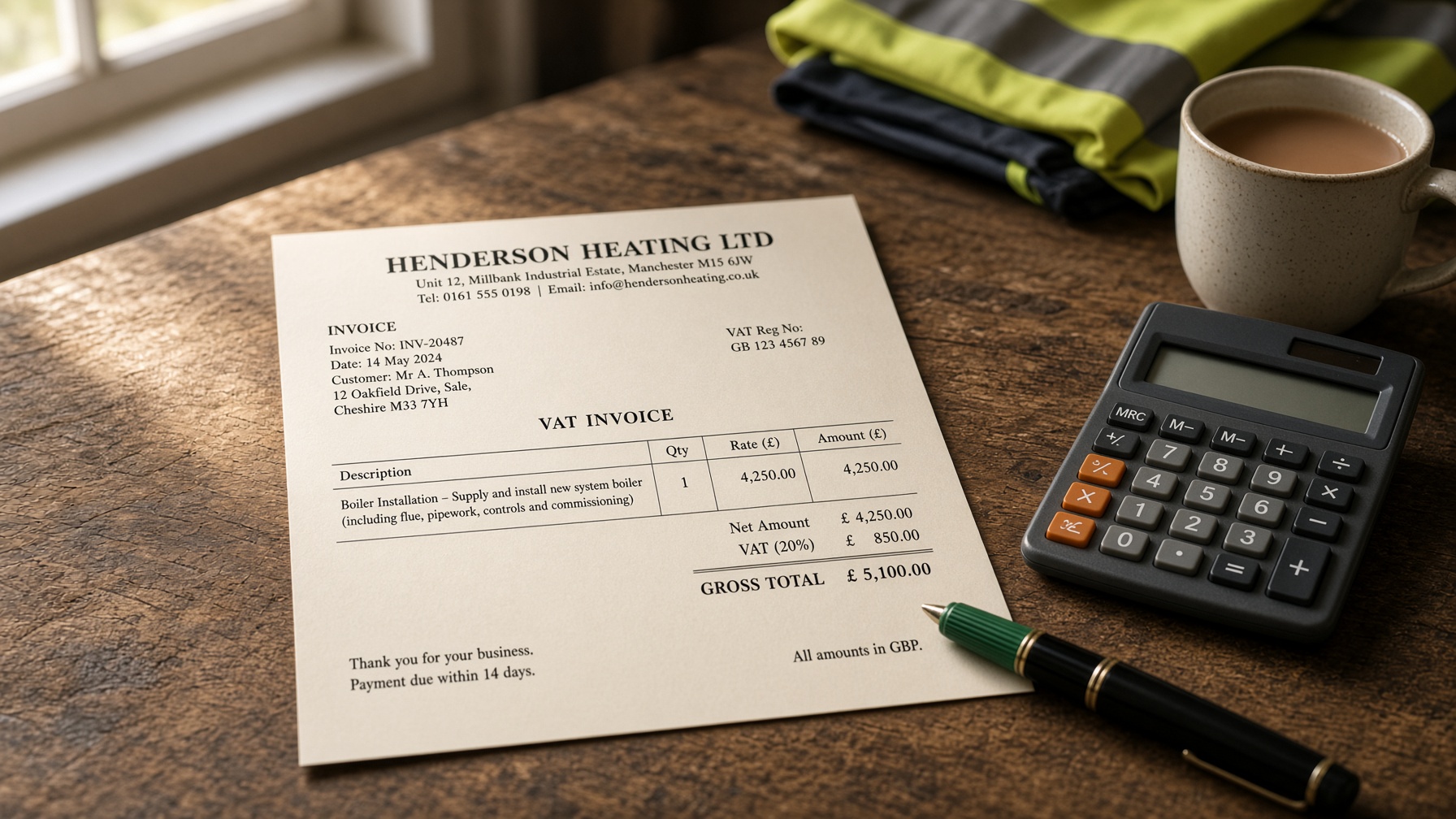
If you are VAT registered, the invoice is a tax document: VAT number, tax point, net / VAT / gross, rate per line. If you are not registered, do not add VAT. The registration threshold is a rolling 12-month taxable turnover set by HMRC — look it up, do not quote a blog.
CIS (construction) is a withholding on labour, not a substitute for VAT. Both can appear on the same page.
European Union
Each member state has its own VAT rate and invoice rules, but B2B invoices between VAT IDs often use reverse charge: you do not add your local VAT; you state that the customer accounts for it. B2C is different, especially for goods (OSS) and for on-the-spot work (often where the work is done).
If you fly to Germany to fit a kitchen, do not assume UK VAT applies because your company is in Kent. Place of supply is the whole game. One written opinion from a VAT practitioner is cheaper than four years of “we always did it this way”.
United States
There is no federal VAT. Sales tax is state (and sometimes local). Many states do not require a “VAT-style” invoice; they require that if you charge sales tax, you show it, and if you did not, you can show why (resale certificate, exempt buyer, service not taxed in that state).
Nexus is the trap. Doing a two-week job in another state, keeping stock there, or crossing economic thresholds can mean you should collect. A US-based 1099 tradesperson invoicing locally still needs a clean invoice: parties, description, date, amount, licence numbers where the trade board cares.
Do not put “VAT 20%” on a US invoice because your template came from MyOnlineInvoice’s UK default. Change the tax name and the rate, or turn tax off.
Canada
GST is federal; HST is a blended tax in participating provinces; QST is Québec. The invoice should show the GST/HST number and the tax as a separate amount. Charging 5% GST in a 13% HST province is how you fund a CRA conversation.
Australia
Once you are GST-registered, many supplies need a tax invoice with ABN and GST shown. A quote is not a tax invoice. The ATO is unromantic about that distinction. If you are under the GST threshold, do not add 10% “to look ready”.
India
GST invoices are data-heavy: GSTIN, place of supply, HSN/SAC, tax split (CGST/SGST vs IGST). E-invoicing is mandated above turnover thresholds that have tightened over time. If you are actually in that net, a pretty PDF from a phone is not the legal invoice — the IRN is.
UAE and Saudi Arabia
UAE VAT is 5% for many supplies; the TRN belongs on the invoice. Saudi VAT is 15%, and e-invoicing (Fatoora) is the compliance project. If you are in Phase 2, sending a branded PDF from a laptop is not “close enough”.
Cross-border in one paragraph
Ask, in this order:
- Where is the supplier established?
- Where is the customer?
- Is it goods or services, and where is the work done?
- Are both parties registered for a consumption tax?
- What does that imply: charge local tax, reverse charge, no tax, or register in the other place?
Write the answer on the invoice (a one-line “Reverse charge — customer to account for VAT” or “Sales tax not collected — out-of-state service”) so their accounts team does not invent a story.
Currency, bank details, how they pay
Name the currency (GBP, USD, EUR, AED, AUD). Put local bank details *and* an international method if they are abroad (IBAN, ACH routing, Pay by Bank where it exists). Do not assume Stripe or PayPal. Many firms cannot use them; many customers still want a card or a bank credit.
The invoice should survive a world where the only working path is a bank transfer with the invoice number in the reference.
A setup that does not lie when you change country
- Legal entity and address in Settings.
- Tax ID field that can hold a VAT number *or* an EIN *or* an ABN.
- Default tax rate that is named (VAT / GST / sales tax / none), not a silent 20%.
- Per-line rate, because mixed supplies exist everywhere.
- Sequential numbers, never reused.
- A note field for reverse charge, exemption, or CIS/withholding.
MyOnlineInvoice already bills in more than one currency. The document still has to tell the truth for the country of the supply.
Use the table on this page as a checklist, then confirm the live rate and threshold where you actually file. Worldwide is not one template. It is five universal lines plus the humility to change the tax story.
Questions people actually ask
- I am a UK plumber invoicing a US household. Do I add VAT?
- Usually you do not charge UK VAT on a supply that is not made in the UK. You also do not invent US sales tax unless you have nexus in that state. Bill in the agreed currency, put both addresses on, and ask the accountant before you copy last month’s 20%.
- I am in Dubai invoicing a UK company. Whose VAT?
- Place of supply for services is messy. Many B2B services are treated as supplied where the customer belongs, which can mean reverse charge on their side and no UAE VAT on yours — or the opposite. Get one written answer from your VAT agent; do not guess from a WhatsApp group.
- Do I need Peppol / e-invoicing?
- If you sell into Italy, Belgium, parts of the EU public sector, India above threshold, or Saudi Phase 2, maybe yes. If you invoice a domestic customer in England from a van, a numbered PDF plus a pay link is still the job. Do not buy a Peppol project you do not have.
- Can one template serve every country?
- One template with the five universal lines plus a tax-ID slot and a tax-rate per line, yes. One set of UK VAT footnotes pasted onto an Australian tax invoice, no.
- What if I am not registered for VAT/GST/sales tax?
- Then do not print a tax column and do not invent a number. The price is the price. Watch the local threshold so you register on time rather than after a letter.
- Should I bill in USD to look international?
- Bill in the currency of the contract. If they pay locally, local currency saves everyone FX. If they are a US firm paying from a US bank, USD can be kinder. Put the currency code on the invoice (GBP, USD, EUR, AED) so nobody wonders.