Field notes
VAT vs GST vs sales tax: what to charge, what to print, what not to invent
Three names for consumption tax, three different invoice jobs. Charging the wrong one is not ‘close’. Here is how a small firm decides what appears on the line, and how to answer the same customer questions in more than one country.
5 Sept 2026 · 8 min read · MyOnlineInvoice
- UK / EU / Gulf
- VAT
- AU / CA / IN / NZ
- GST
- United States
- Sales tax
- If unregistered
- None
Invoice is often a tax document
Tax invoice rules vary
State nexus, not IRS VAT
Do not print a fake column
Process
- 1
Name the tax you are actually registered for
VAT, GST, HST, sales tax — or none.
- 2
Never copy a 20% default into a new country
Change the rate and the label the day you set the business country.
- 3
Per line, not a mystery total
Mixed rates exist. Show them.
- 4
Exemption needs a reason
Resale certificate, reverse charge, out-of-scope — a word on the page.
- 5
Keep the official bookmark
GOV.UK, IRS/state DOR, CRA, ATO, GSTN, FTA, ZATCA.
By country
Checklist, not a filing. Confirm the live rate with that authority.
| Region | Tax | ID on the invoice | Must print | Watch |
|---|---|---|---|---|
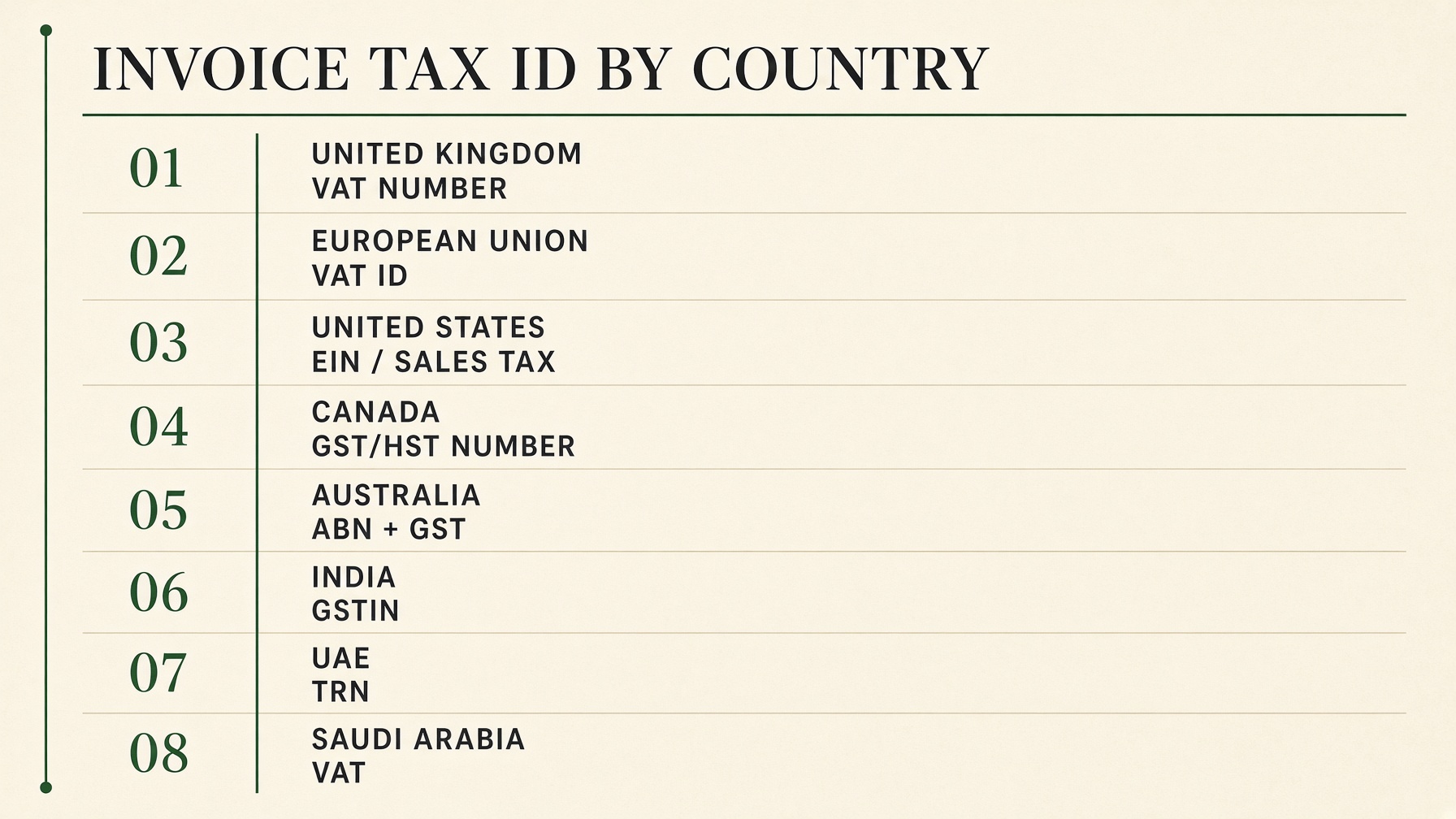
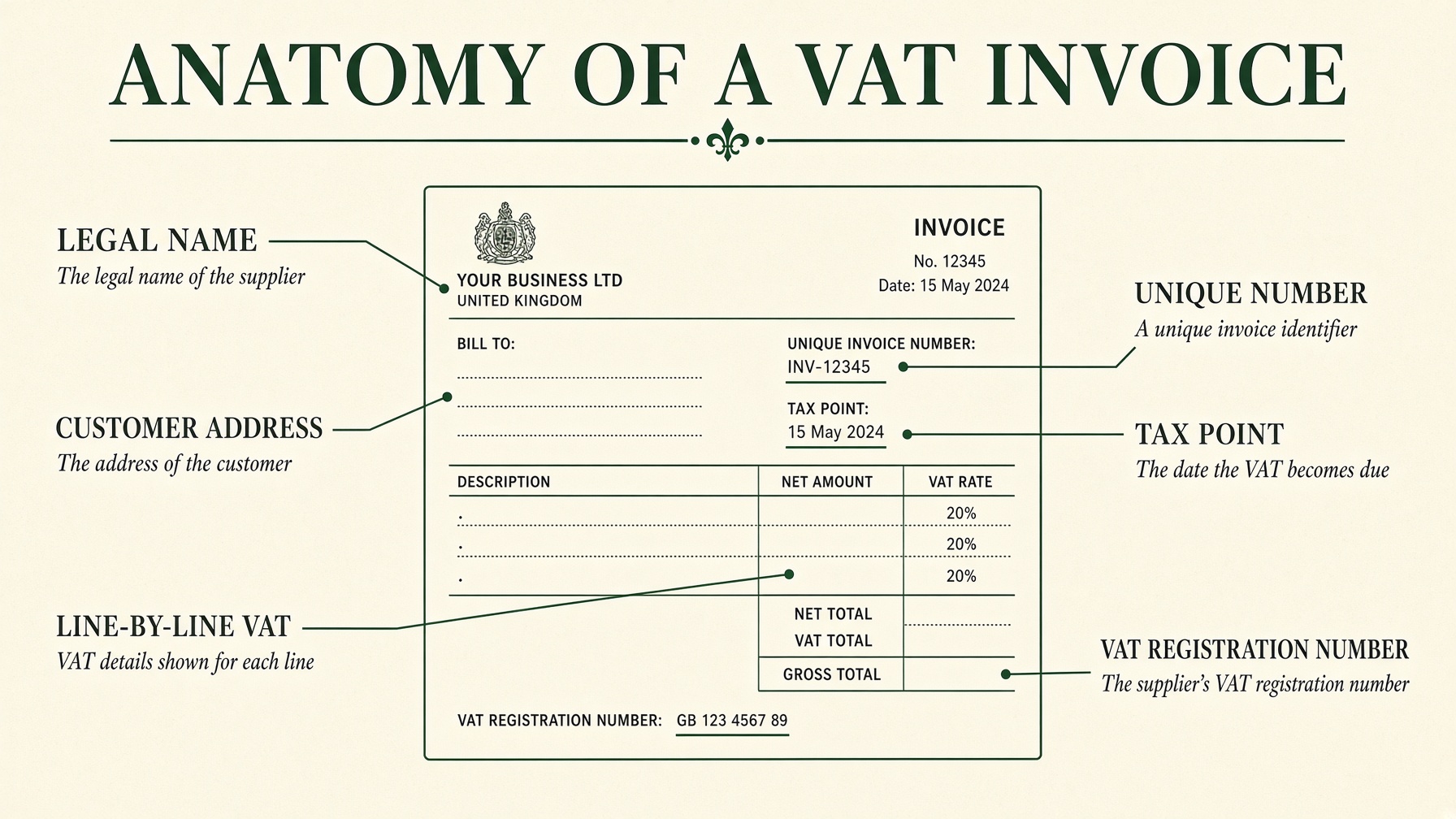
| United Kingdom | VAT (usually 20%) | VAT number (GB…) | Legal name, unique invoice no., tax point, net/VAT/gross, customer address | Do not charge VAT if you are not registered. Threshold is set by HMRC — confirm on GOV.UK. |
| European Union | VAT (country rate) | VAT ID (prefix + number) | Full VAT invoice for B2B; reverse charge note if you invoice another VAT ID | Distance sales / OSS for B2C goods. Services have different place-of-supply rules. Confirm in that member state. |
| United States | State sales tax (not federal VAT) | EIN on the document; sales-tax permit in the state | Who you are, who they are, description, date, amount, tax charged (or exempt reason) | Nexus is state-by-state. A job in another state can create a collection duty. No national invoice statute like VAT. |
| Canada | GST / HST (and QST in Québec) | GST/HST number | Business name, GST/HST number, invoice date, amount, tax shown separately | HST vs GST+PST depends on the province of the supply. Québec has QST as well. |
| Australia | GST 10% | ABN; GST if registered | Identity, ABN, what was supplied, GST amount (tax invoice rules) | A ‘tax invoice’ is a defined document once you are GST-registered. Quotes are not tax invoices. |
| India | GST (CGST/SGST or IGST) | GSTIN | GSTIN of both sides where required, HSN/SAC, place of supply, tax breakup | E-invoicing turnover thresholds apply to many firms. Interstate vs intrastate changes the tax split. |
| United Arab Emirates | VAT 5% | TRN | TRN, sequential invoice, Arabic may be required on some records, tax amount | Designated zones and reverse charge on certain imports. Confirm with FTA guidance. |
| Saudi Arabia | VAT 15% | VAT registration number | ZATCA e-invoicing (Fatoora) for many taxpayers — Phase 1/2 rules | Paper-looking PDFs are not enough if you are in the e-invoicing phases. Integration is the product. |
VAT, GST and sales tax are three answers to “does the government want a slice of this sale, and who collects it?” They are not interchangeable stickers.
| Region | What you collect | What the invoice calls it |
|---|---|---|
| UK / EU / Gulf | VAT (if registered) | VAT, reverse charge, or none |
| Australia / NZ / Singapore | GST | Tax invoice + ABN/GST |
| Canada | GST or HST (+ QST) | GST/HST shown separately |
| India | GST (CGST/SGST or IGST) | GSTIN + place of supply |
| United States | State sales tax | Sales tax — never VAT |
| Unregistered anywhere | Nothing | No tax column, no fake ID |
The invoice is where you either collect correctly or train your customer to pay the wrong amount. This piece is the decision tree for a small firm. Confirm live rates and thresholds with the authority you actually file with.
First question: are you registered?
If you are not registered for VAT/GST/sales tax in that country, you generally must not charge it and must not invent a number. The price is the price.
Watch the local threshold. UK VAT, Australian GST, Canadian GST, UAE VAT — each has a trigger. US sales tax is not a national threshold; it is nexus in a state.
Registering “to look bigger” is how you take on filing you are not ready for. Not registering when you have crossed the line is how you take on penalties.
VAT (UK, EU, many Gulf states, others)
VAT is invoiced by the supplier (unless reverse charge). The invoice often *is* the tax document: tax ID, tax point, net, VAT, gross, rate. Input VAT is reclaimed on the other side with that document.
Reverse charge (common EU B2B): you charge 0, you say so, the customer accounts for VAT. Missing the sentence is how their auditor rejects the bill.
Reduced, zero, exempt are legal categories, not discounts. Energy-saving materials, food, exports, financial services — all have rules that change. If a Facebook group gave you 5%, read the notice.
GST (Australia, New Zealand, India, Singapore, Canada’s federal piece)
GST is also a value-added style tax in many countries, but the invoice title matters. Australia wants a tax invoice once you are registered. India wants GSTIN and a tax split. Canada wants the GST/HST number and the tax shown.
Do not print “VAT” on a GST invoice. The word is a filing system, not a synonym.
Sales tax (United States)
Origin or destination, state by state. Many services are untaxed in some states and taxed in others. Marketplace rules, economic nexus, and local rates on top of state rates are why US firms buy sales-tax software.
For a one-person trade: if you work in one state, charge what that state tells you, show it as sales tax, keep exemption certificates. If you cross state lines, ask before you copy last job’s rate.
There is no US “VAT number” to print. An EIN identifies the business to the IRS. It does not magically collect Ohio tax.
What the line on the invoice should look like
- Name the tax: VAT 20%, GST 10%, HST 13%, sales tax 6.25%, reverse charge, or no tax.
- Show tax amount and gross.
- If mixed rates, per line.
- If exempt, why.
A single “plus tax” at the bottom is how two honest people disagree by four hundred units of currency.
Withholding is not consumption tax
CIS (UK construction) and similar withholding regimes take a slice of labour for the tax authority. They sit next to VAT, not instead of it. A US backup-withholding situation is the same idea in a different suit. Show the deduction as its own line so the net payable is obvious.
How to answer the same question in four kitchens
“Can you add VAT? I want to reclaim.” Only if you are VAT-registered in a system that lets them reclaim. Otherwise no.
“We don’t pay sales tax, we’re a reseller.” Then they give you a certificate. You keep it. You do not take their word in the hallway.
“Just do it like last time.” Last time may have been another country. Open Settings. Look at the tax name.
“Put it all as materials, less paperwork.” No. That is how you and they both file fiction.
A worldwide default you can live with
- Country of the business in Settings.
- Tax system named, or explicitly none.
- Current rate from the official page, reviewed when you raise prices — not “whenever”.
- Invoice template with ID + rate + net/tax/gross.
- A written reverse-charge / exemption sentence you can paste.
- Accountant for the second country before the fifth invoice there.
Worldwide invoicing is not a globe icon. It is refusing to export your first country’s tax onto someone else’s return.
Questions people actually ask
- Is GST just VAT with another name?
- They are both consumption taxes, but the invoice rules, thresholds, and credits differ. Treat them as cousins, not copies. Australia’s tax invoice and India’s GSTIN invoice are not a UK VAT invoice with the logo swapped.
- Can I charge US sales tax on a service I did from London over Zoom?
- Usually you have no US sales-tax collection duty just because the customer is in Ohio. Software, SaaS and remote services are a specialist mess. Do not add 7% ‘to be safe’. Safe is a written position.
- My customer in Ireland asked for reverse charge. What do I print?
- Their VAT ID, your VAT ID, net amount, zero VAT, and a line that says the customer accounts for VAT under reverse charge. If you are not VAT-registered, you cannot play this game — you are not in the VAT system.
- What rate is UAE VAT?
- The standard rate has been 5% for most supplies. Some are zero-rated or exempt. Confirm on the Federal Tax Authority site before you print.
- Saudi says I need e-invoicing. Does a MyOnlineInvoice PDF count?
- For Phase 2 taxpayers, ZATCA expects integrated e-invoices, not a PDF emailed from a laptop. The PDF may still be what the customer reads; the legal invoice is the cleared one. Do not pretend otherwise.