Field notes
What a UK VAT invoice actually has to include (and what HMRC ignores)
A VAT invoice is a tax document that happens to request money. Miss the statutory lines and your customer cannot reclaim; invent VAT when you are not registered and you have a different problem.
3 Sept 2026 · 8 min read · MyOnlineInvoice
- VAT threshold
- £90k
- Must-have lines
- 6
- Standard rate
- 20%
- Keep records
- 6 yrs
Taxable turnover, rolling 12 months (check GOV.UK)
Name, number, tax point, parties, rates, totals
Most labour and materials on domestic repairs
Invoices are part of your VAT account
Process
- 1
Confirm you are actually VAT registered
If you are not, do not add VAT and do not invent a number. The price is the price.
- 2
Put your legal name and VAT number in Settings once
Every invoice inherits them. Do not retype GB numbers on a wet Tuesday.
- 3
Rate on the line, not a mystery total
20%, reduced, zero, exempt — per line. Totals then add up in public.
- 4
Tax point = invoice date unless you have a reason
Deposits and continuous work have rules. For a one-off job, keep it boring.
- 5
Never recycle invoice numbers
INV-00041 then INV-00042. Gaps you can explain; resets you cannot.
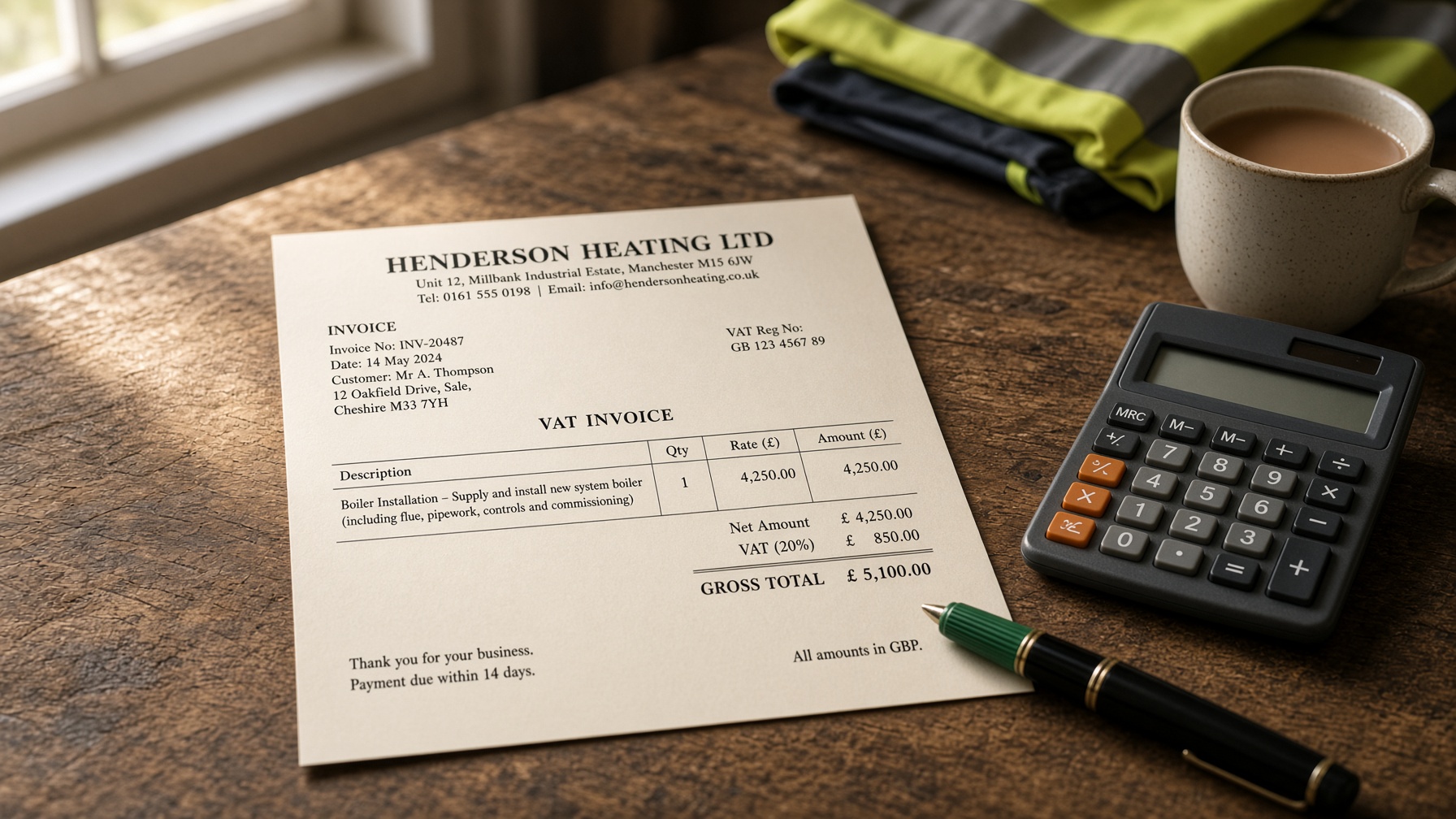
If you are VAT registered, every invoice you send is a tax document that also happens to ask for money. Customers who reclaim VAT will bounce anything missing a number. HMRC does not care that your template looked clean.
This is the short statutory list, then the messy bits trades actually hit: mixed rates, deposits, estimates dressed as invoices, CIS, and the threshold.
It is a field guide. It is not a substitute for GOV.UK or an accountant. Thresholds and energy-saving rates move; the *shape* of a valid invoice does not.
The lines that have to be there
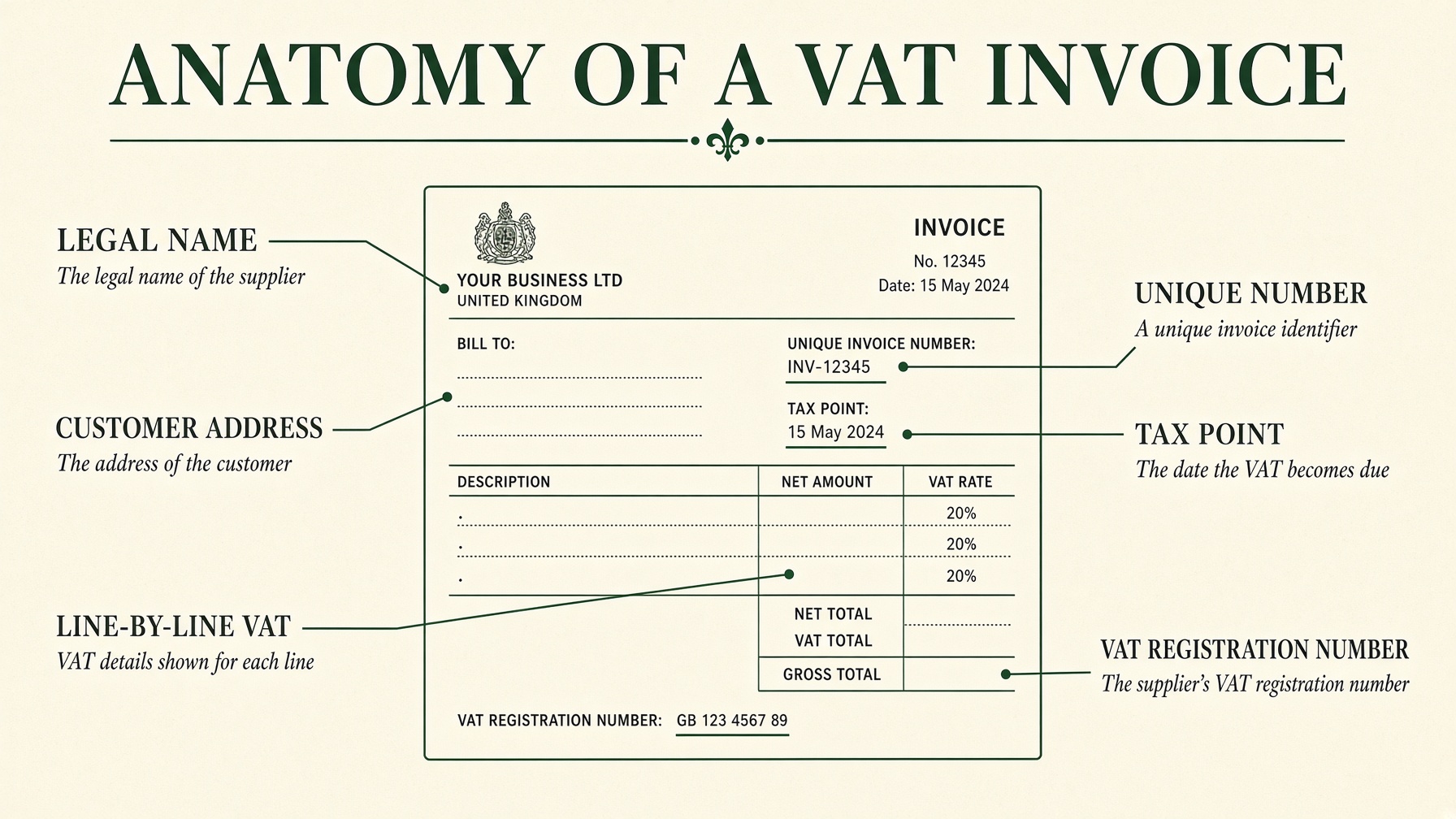
For a full VAT invoice, you need:
- Your name and address (the legal entity — FullForce LTD, not “Dave the plumber” unless that is the legal name).
- The customer’s name and address.
- A unique invoice number.
- The invoice date and a tax point (often the same).
- A description of the goods or services.
- Net, VAT, and gross, with the rate shown.
- Your VAT registration number.
That is the core. Unit price and quantity belong there when they exist. For a day-rate plus materials, show both. “To plumbing as discussed — £2,400 + VAT” is how disputes and failed reclaim start.
MyOnlineInvoice fills the repeating lines from Settings so you are not typing a VAT number in the rain. The description and the rates are still your job.
Simplified invoices
For smaller amounts, HMRC allows a simpler invoice (less detail). Do not hide behind that on a £12,000 bathroom. If a VAT-registered customer needs to reclaim, give them a full invoice. It costs you nothing extra.
Rate on the line, not a mystery total
If some lines are 20% and a qualifying installation is reduced-rated, show the rate per line. A single “plus VAT” at the bottom is how you and the customer disagree by £400 and neither of you can point at a line.
Exempt or out-of-scope work should say so, not sit in the same lump as the rest. Labour and materials on the same job can have different treatments; guessing “it is all 20%” is often right for a repair and sometimes wrong for a specified installation. When in doubt, one rate, documented, from your accountant — not from the van WhatsApp group.
Call-outs, parking, materials at cost
If you charge it, it is usually part of the consideration. “Materials at cost, no VAT” is not a thing if you are VAT registered and selling those materials as part of the job. Your input VAT and output VAT are a system. Do not freelance a third category called “mate’s rates”.
Estimates are not invoices
An estimate can look like an invoice and still not be one. Status should be obvious to a tired customer on a phone:
- Estimate / quote — this is an offer. It should say so in the header. It should expire.
- Invoice — unique number, tax point, amount due, how to pay.
- Credit note — when you got it wrong or they returned part of the job.
When they accept, convert the estimate. Do not keep marking up the same PDF for six weeks until nobody can say what was agreed. That muddle is how people pay the original quote and ignore the extras.
Numbering stays dull: INV-00041, INV-00042. No resetting each month, no favourite numbers, no “INV-BATH-JAMES”. Accountants and HMRC both prefer a sequence you can explain in one sentence. Gaps happen (voided drafts); resets look like a second set of books.
Tax point, deposits, and “when is this supply?”
For a one-off job, the tax point is usually the invoice date or the date you completed the work / received payment, whichever rules apply to that supply. In practice: finish the job, invoice the same day, tax point = invoice date. Boring is correct.
Deposits are where people invent law. A deposit that is consideration for a supply can create a tax point when you receive it. If you take 30% to book a slot, that 30% often wants its own invoice (or a clearly identified stage), not a note in a text. When the job completes, the final invoice references what is already paid.
If this paragraph made you uneasy, that is the point at which you ask the accountant, not the group chat.
If you are not VAT registered yet
Do not add VAT. Do not invent a VAT number. Do not print a VAT column with zeros to “look ready”. The price is the price. Say so.
Watch the rolling 12-month taxable turnover. The registration threshold is set by HMRC (it moved to £90,000 from 1 April 2024 — confirm the current figure on GOV.UK). Going over and not registering is more expensive than the admin of registering.
When you do register, turn VAT on in Settings and new invoices pick it up. Old invoices stay as they were. You do not go back and “VAT” a job you already billed as non-VAT.
CIS and subcontractors
Construction Industry Scheme deductions are not VAT. A main contractor may withhold CIS on labour. You may still have to charge VAT on the supply if you are registered. Put both on the document so the accounts team can see:
- Gross labour
- CIS withheld
- VAT on the VAT-able amount
- Net payable
If your invoice just says “£2,000” and they “sort it”, you will be paid something you cannot reconcile.
Records, credits, and the six-year drawer
Keep copies of invoices issued and received. Digital is fine. A credit note needs a unique number and a reference to the original invoice. Do not delete INV-00041 and reissue INV-00041 with a new amount. That is how VAT returns and customer purchase ledgers diverge.
If you cancel a job after invoicing, credit it. If you under-billed, issue a second invoice for the extra — or a replacement only if the original was never sent and never in anyone’s books.
A practical setup that survives a VAT inspection
- Legal name, address, VAT number stored once.
- Sequential invoice numbers, never reused.
- Line-level rates, then net / VAT / gross totals.
- Tax point visible.
- Estimates labelled as estimates.
- Deposits invoiced, not buried.
- Credit notes for corrections.
- Export or PDF archive you could hand over without opening WhatsApp.
Get those eight right and you look like a firm. The template colour is irrelevant. Speed of sending still matters more than a prettier layout — but a prettier layout that is missing the VAT number is a liability.
When you want the document to also get you paid, pair this with a due date and a pay link. Tax compliance and cashflow are different jobs. Do both on the same page.

Questions people actually ask
- I am under the VAT threshold. Can I still show VAT?
- No. You cannot charge VAT if you are not registered. Do not put a VAT column on the invoice. If a customer asks for a VAT invoice, the honest answer is that you are not registered.
- Do I charge VAT on call-out fees?
- If you are VAT registered, a call-out is almost always standard-rated. It is consideration for a supply. Putting it as ‘expenses’ does not make it disappear.
- What about the 5% or 0% rates on energy-saving materials?
- Some installations of qualifying energy-saving materials can be reduced or zero-rated, with conditions that change. Do not guess from a Facebook group. Check the current GOV.UK notice or ask your accountant before you print 5% on a heat pump.
- Can I issue a VAT invoice for an estimate?
- No. An estimate is not a tax invoice. When they accept, convert it. The VAT invoice is the document with the unique number and tax point.
- I sub to a main contractor — CIS or VAT?
- Both can apply. CIS is a deduction on labour for construction; VAT is a tax on your supply if you are registered. They are not substitutes. Get the two numbers straight on the invoice so nobody ‘helps’ by withholding twice.